The Silent You
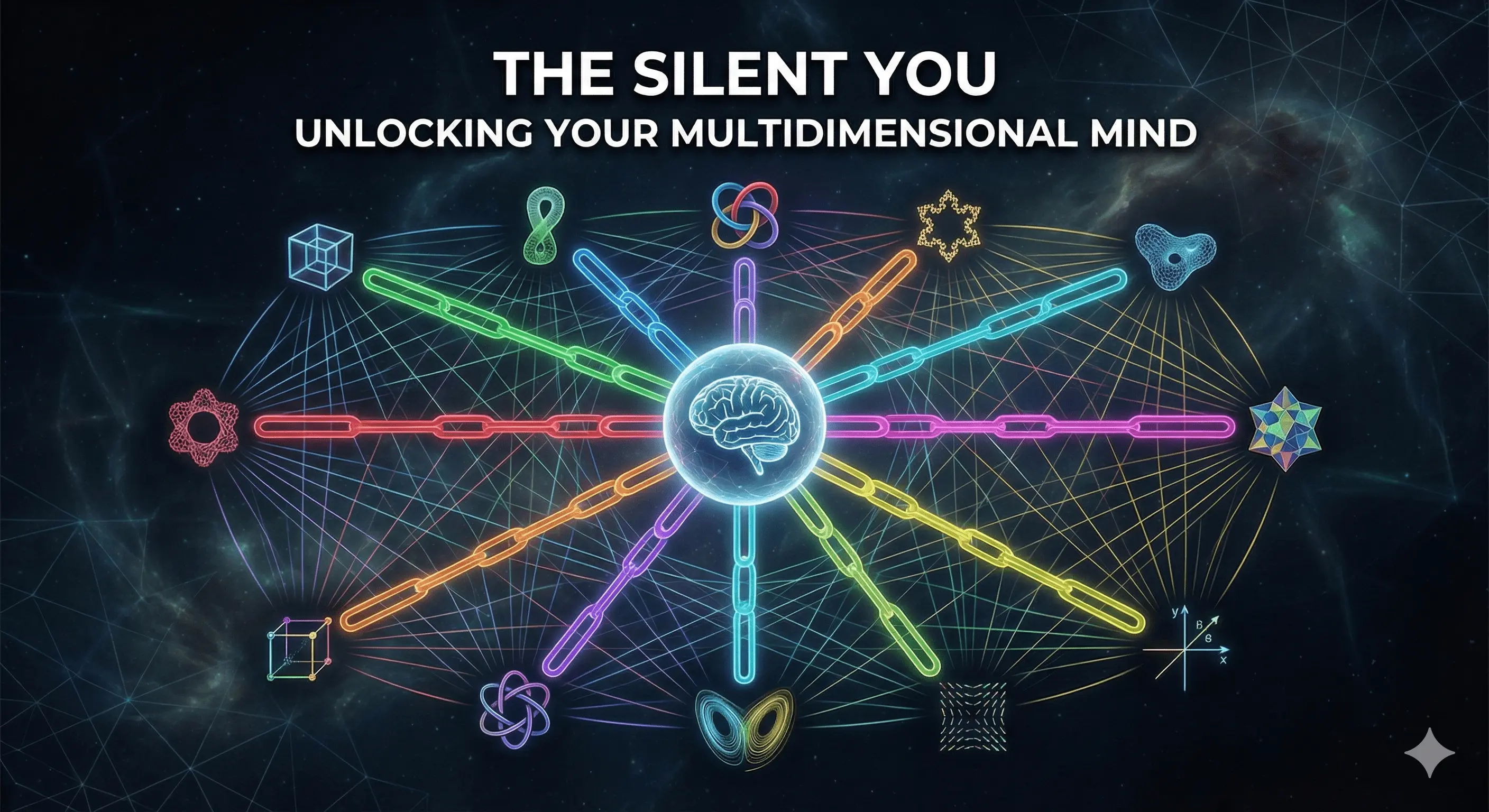
Introduction: Entering the Silence
But beneath this surface-level static, there is a quieter, more profound layer of intelligence that most of us overlook. This is the realm of what I call the Silent You—the vast, subtle, and incredibly swift consciousness that guides much of our behavior, intuition, and perception without ever speaking in full sentences. It communicates in flashes, feelings, images, and whispers.
Imagine for a moment that you could press a mute button on the loud narrator in your head and tune into this deeper frequency. What would you learn if you could hear the subtle signals your body is sending you? How would your life change if you could tap into this hidden dimension of your mind, a dimension that has been there all along, just waiting for you to learn its language?
This book is your guide to learning that language. It's about learning to listen—not with your ears, but with your full attention—to the tiny, almost imperceptible signals that architect your reality. Through this journey, you will venture beyond linear, conscious thinking and into the multidimensional complexity of the mind. By developing this new kind of listening, you will empower yourself to make clearer decisions, ignite your creativity, and finally meet the true architect of your internal world.

The Practice of Subtle Archaeology
Our conscious mind is like an archaeologist working on the surface of a dig site, carefully brushing away dirt to uncover large, obvious artifacts—our deliberate thoughts, plans, and memories. This work is important, but the real treasures often lie deeper, in layers that have been untouched for years. These are the micro-thoughts: the tiny, fleeting fragments of insight, intuition, and emotion that flash through our awareness in milliseconds.
These are the whispers beneath the roar of your internal narrator. You've experienced them before:
- A sudden, inexplicable urge to take a different route home, only to later find out you avoided a major traffic jam.
- The face of a long-lost friend popping into your mind, moments before they call you.
- A flash of an image that contains the perfect solution to a problem you've been stuck on for days.
These moments aren't random. They are signals from the Silent You. The practice of catching them is a form of subtle archaeology—learning to gently sift through the layers of your consciousness to uncover the hidden gems of wisdom buried within.
The Practice: The Three-Minute Dig
Set a timer for three minutes. Close your eyes and take a few deep breaths. Your goal is not to empty your mind, but to become a patient observer of it. Let your loud, deliberate thoughts come and go like clouds passing in the sky. Your focus is on the space between the clouds. What do you notice in those brief moments of quiet? A fleeting image? A single word? A faint bodily sensation? Don't analyze or judge it. Just acknowledge it: "Ah, there's one."
Scientific Basis
This practice directly engages with the brain's default mode network (DMN). The DMN is a web of brain regions that becomes active when we are not focused on an external task—when we are daydreaming, reflecting, or simply being. This network is the brain's sandbox, where it connects disparate ideas, processes memories, and simulates future possibilities.

Chapter 2: The Thought Highway
As you become more adept at noticing micro-thoughts, you'll realize they don't appear in isolation. They are part of a vast, high-speed network I call the Thought Highway. If your conscious, linear thoughts are like a person walking down a quiet country road, the Thought Highway is a multi-lane superhighway where information travels at incredible speeds.
These thoughts are so fast and fragmented that your conscious mind usually can't register them. However, they are not without effect. They are the subliminal drivers of your mood and behavior. A fleeting micro-thought of a past failure can trigger a wave of anxiety without you ever knowing why. A split-second image of a happy memory can subtly lift your spirits. You're feeling the emotional exhaust of thoughts that have already sped by.
The Practice: The Mental Replay
The next time you feel a sudden, unexplained shift in your mood—a pang of sadness, a jolt of irritation, a wave of warmth—stop. This is your cue that a significant thought just sped by on the Thought Highway. Hit the mental "pause" button and ask yourself: "What was happening in my mind one second before I felt this?"
Gently rewind. You might not catch the thought as a full sentence, but you might recall a flicker of an image, a faint internal voice, or a memory. By practicing this "mental replay," you train your brain to slow down its perception of the highway, allowing you to eventually read the license plates of the thoughts that are shaping your emotional state.
Scientific Basis
Psychological studies on priming demonstrate the power of the Thought Highway. In these experiments, subjects are exposed to a stimulus (like a word or image) so quickly that they don't consciously perceive it. Yet, this subliminal exposure influences their subsequent thoughts and actions. This is the Thought Highway in action. The micro-thoughts you experience are internal primes, subtly nudging you in directions that your conscious mind hasn't yet approved—or even noticed.
Chapter 3: Tuning the Radio of Your Mind
Imagine your mind is a sophisticated radio receiver, capable of tuning into thousands of different frequencies simultaneously. Some of these frequencies are filled with static—the repetitive loops of worry, self-doubt, and fear. These are the stations we often get stuck on, listening to the same dreadful broadcast day after day.
But other frequencies are broadcasting something entirely different: clarity, creativity, insight, and calm. These are the channels of the Silent You. They are often quieter, with a weaker signal, but they are always there. Learning to listen to micro-thoughts is the act of fine-tuning your mental radio. It's about consciously adjusting the dial away from the static and toward the frequencies that empower and inspire you.
The Practice: Changing the Station
Sit quietly and identify the dominant "station" your mind is currently playing. Is it the "Worry FM" station, broadcasting a continuous loop of future anxieties? Is it the "Criticism AM" station, critiquing your every move?
Acknowledge the station without judgment. Then, deliberately search for a different frequency. Scan your awareness for a single, positive micro-thought. It could be a feeling of gratitude for the comfortable chair you're sitting in, a fleeting memory of a loved one's smile, or an image of a peaceful place. Latch onto that thought. Hold it in your awareness. Give it your attention.
The more you practice this, the stronger that new signal will become. You are using your focus to amplify the frequencies you want to hear.
Scientific Basis
This practice is a direct application of neuroplasticity. When you repeatedly focus your attention on certain types of thoughts, you strengthen the neural pathways associated with them. It's like turning a faint dirt path in your brain into a well-paved road. By consciously choosing to "tune in" to positive and constructive micro-thoughts, you are literally rewiring your brain to make those states of mind more accessible and automatic over time.
Chapter 4: Seeing a Feeling
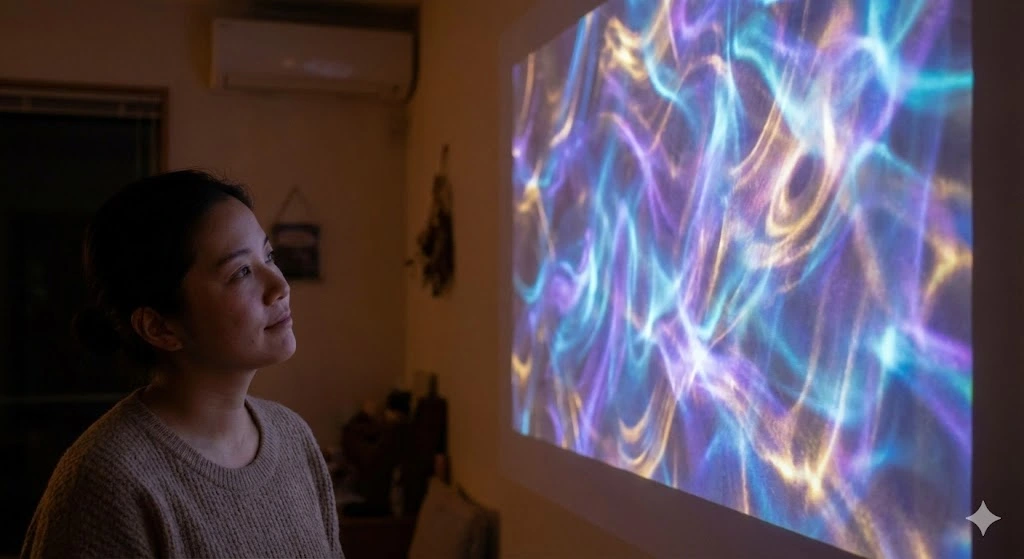
Have you ever had an "aha!" moment where a complex solution appeared in your mind, fully formed, before you could even begin to articulate it? That experience is a glimpse into your mind's native language: multidimensional thought.
Our education system trains us to think in lines—sentences, equations, logical steps. But the brain doesn't think in lines; it thinks in webs. A single thought is not just a string of words. It's a rich, multi-sensory event that can include:
- An image (a mental picture of the solution)
- An emotion (a feeling of excitement or certainty)
- A bodily sensation (a lightness in your chest or a tingling in your hands)
- A conceptual link (an abstract connection to a past experience)
When we try to explain these insights, we are forced to flatten this complex, multidimensional experience into the single dimension of linear language. It's about describing a vibrant, three-dimensional sculpture by listing its measurements. You convey some information, but you lose the essence of the art.
The Practice: Deconstructing an Insight
Recall a recent "aha!" moment, no matter how small. Instead of focusing on the verbal explanation of the insight, explore its other dimensions. Close your eyes. Where did you feel that insight in your body? Was it a warmth in your gut? A release of tension in your shoulders? What was the emotional flavor? Was it relief? Joy? Confidence? Was there an image or a symbol associated with it, even an abstract one?
By deconstructing the thought into its sensory components, you learn to recognize and value the non-linear, non-verbal ways that your deeper mind communicates with you.
Scientific Basis
Neuroscience confirms that complex problem-solving and creative insights involve a holistic activation of the brain. It's not just the logical, language-processing areas that light up. Brain scans show simultaneous activity in the visual cortex, emotional centers like the amygdala and insula, and memory hubs like the hippocampus. A thought is a symphony played by the entire orchestra of your brain.
Chapter 5: The Multidimensional Mind
Imagine a single thought not as a point, but as a crystal with many facets. One facet is logic, another is emotion, another is memory, and yet another is a gut feeling. A truly wise decision is made not by looking at just one facet, but by seeing the whole crystal and how the light of awareness refracts through it. Its made by how the orchestra plays the symphony.
The Blue Brain Project, a Swiss research initiative, has created digital reconstructions of brain tissue that suggest our brains process information in ways that can be described using multi-dimensional mathematics. While the science is complex, the takeaway is simple: your mind is designed to process reality in a far more sophisticated way than just linear thinking.
The Practice: The Facets of a Decision
Think of a decision you are currently facing. Instead of just listing pros and cons (a linear approach), explore its different dimensions:
- The Logical Facet: What does reason and data suggest?
- The Emotional Facet: How do you feel about each option?
- The Intuitive Facet (Gut Feeling): If you had to choose in one second, what would your gut say?
- The Somatic Facet (Body): How does your body react? Lightness vs. heaviness?
- The Visionary Facet: What future image does each option create?
Chapter 6: Gut Feelings as Multidimensional Thoughts
A "gut feeling" is actually a rapid, subconscious process occurring in the brain (basal ganglia and prefrontal cortex). When the brain recognizes a pattern matching a past experience, it generates a physical sensation in the body (the gut) to alert you before you are consciously aware of why. The gut is not "thinking"; it is acting as a resonant board for the brain's subconscious processing.
Scientific Basis
The gut-brain axis is the biochemical highway that connects your digestive system to your brain. Your gut contains over 100 million neurons—sometimes called the "second brain"—and it is in constant communication with your head. That "gut feeling" is a very real, physiological signal from your second brain.
Chapter 8: The Constellation of Time

We often think of time as a straight line, but our memories and future thoughts do not work that way. Instead of a single, flowing river, think of your memory as a constellation. When you recall a moment, you are not pulling a single file from a folder; you are activating a network of associated feelings, images, sounds, and other interconnected nodes.
This is why a single song or scent can instantly transport you back to a specific moment, triggering an entire network of dormant feelings. By practicing multidimensional thinking, you gain the ability to access these memories in their original, holistic data structure. You don’t just remember the "story" of a childhood day at the beach; you access the warmth of the sun and the feeling of the sand all at once.
This same networked principle applies to your future. It is not a predetermined path, but a vast field of potential. Every choice you make shapes the entire landscape of what comes next. Think of each decision as a fork that creates new nodes in your life’s network, allowing for connections that were not possible before. By consciously choosing your actions in the present, you are actively building the architecture of your future.
The Practice: Accessing the Holistic Data
Choose a positive memory from your past. Instead of recounting the events (the linear story), try to find the sensory and emotional nodes. Close your eyes and focus on the temperature of the air, the specific "color" of the emotion you felt, and any background sounds.
As you hold these nodes, notice how the memory feels more "solid" and multidimensional. You are training your mind to unlock the vast, living library of your own experience.
Scientific Basis
Memory "reconsolidation" shows that every time we recall a memory, it becomes malleable. We aren’t accessing a static recording; we are "re-firing" a specific neural network. By focusing on the multidimensional nodes of a memory, we strengthen the synaptic connections across different brain regions—sensory, emotional, and cognitive—making our "living library" more accessible.
Chapter 9: From Practice to Power
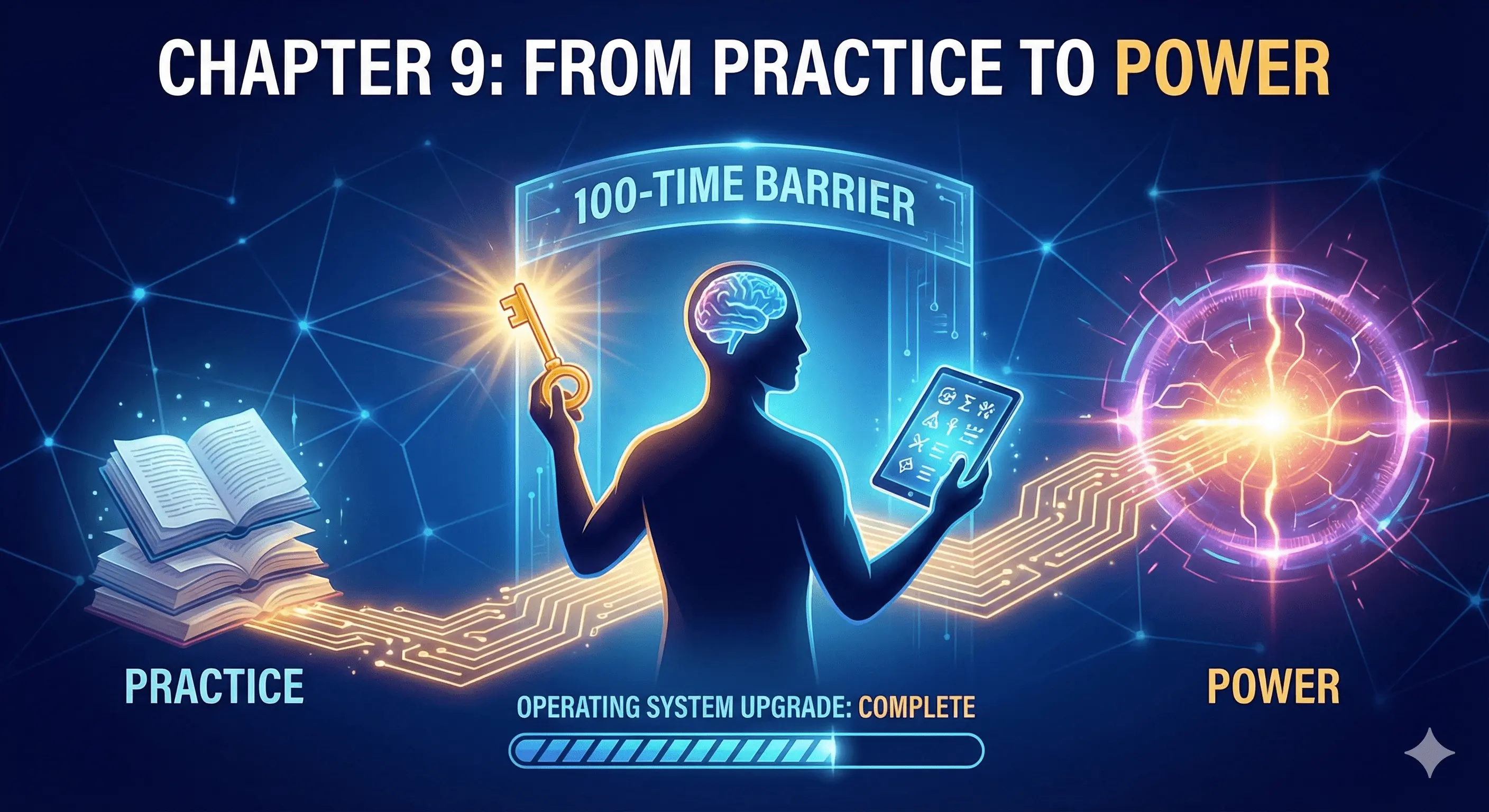
Something incredible starts to happen when you learn to trust your unconscious mind. Once you move past simply acknowledging it's there and begin to recognize the patterns in this new sense, your entire operating system begins to upgrade.
Expect to get your gut feelings wrong sometimes. That's completely normal. Think of it as learning a new language. But after you cross what I call the 100-Time Barrier, something shifts. You've built a reliable translation key between your feelings and their meanings.
Conclusion: Meeting the Architect
By learning to listen to the "Silent You," you aren't just gaining a mental trick; you are reclaiming a part of your humanity that the modern world has taught you to ignore. You are moving from being a passive passenger in your own mind to becoming a conscious collaborator with your deeper intelligence.